
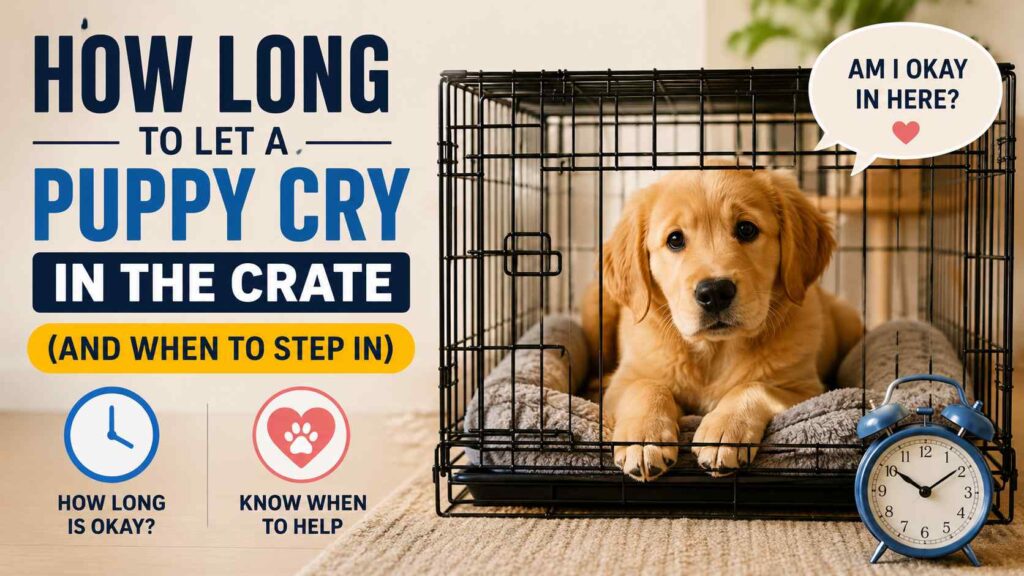
Nobody enjoys standing outside a crate listening to a puppy cry. It pulls at two instincts that go in opposite directions: comfort a distressed animal, or avoid teaching them that crying works. There’s no stopwatch number that applies to every dog. What matters more is what kind of crying you’re hearing, not how many minutes have passed.
If your puppy’s basic needs are covered — recently out to potty, had some exercise, not unwell — a few minutes of grumbling or on-and-off whining is often just noise while they settle, and it’s fine to let that pass without opening the door mid-cry. If the crying doesn’t ease up, gets more frantic, or comes with signs of real panic, that’s different, and it’s worth checking on them.
Why Puppies Cry in the Crate
A crate is a small, enclosed space, and for an animal that only recently left its mother and littermates, being alone in one can feel like a big deal. A few things are usually going on, sometimes at once:
- Their bladder is small. Puppies under about five months old can’t hold it for long, so crying is sometimes a real signal, not just noise.
- The crate hasn’t been built up as a good place yet. Left there for the first time without a gradual introduction, it reads as confinement rather than a den.
- They’re overtired or overstimulated, and the crying is general restlessness rather than distress about the crate itself.
- It worked before. If crying has ever been followed quickly by the door opening, a puppy learns fast that vocalizing gets a response.
- They’re genuinely afraid. Some puppies find confinement frightening early on, and that fear can sound like ordinary fussing at first.
None of these reasons mean something has gone wrong — they just call for different responses.
Protest Crying vs. Real Distress
This is really the question underneath “how long should I let them cry,” because the answer depends on which kind of crying you’re dealing with.
Protest crying starts strong right when you leave, then tapers off within a few minutes. It sounds like whining, grumbling, or intermittent barking rather than nonstop screaming, and it mostly shows up in the first days or weeks of crate use, shrinking as the routine becomes familiar.
Distress crying looks different. It continues steadily without dipping in intensity, or escalates into louder, more frantic sounds or howling. It often comes with heavy panting, drooling, shaking, or frantic scratching at the door — and it tends to happen every time, with little improvement over days or weeks.
Hearing the first pattern, it’s generally fine to give it a little space. Hearing the second, your puppy is telling you something needs to change now.
So, How Long Should You Actually Wait?
There’s no scientifically established number of minutes that fits every puppy, and treating this like a countdown timer misses the point. A short framework is more useful than a number.
In any single session, once you’re confident needs are met, a few quiet minutes of protest crying is reasonable to let pass. Many trainers recommend not opening the door while your puppy is mid-cry, since letting them out at the peak of the noise can teach them that crying ends the confinement. Waiting for even a brief pause before opening the door connects the release to calm rather than crying.
Across the first days and weeks, crying is normally more frequent and intense at the start, then shrinks as your puppy learns the crate isn’t a threat — often within one to two weeks of consistent, positive use. If it isn’t improving at all after several weeks of a calm, gradual approach, that’s worth attention rather than more waiting.
On overall time in the crate, a commonly used rule of thumb is about one hour per month of age — so a three-month-old might manage roughly three to four hours. Treat this as a rough guide, not a hard limit, and don’t push it as routine, especially overnight or with very young puppies.
None of this means letting a puppy cry indefinitely is the goal. The aim is a short, calm wait when you’re confident it’s protest — not ignoring your puppy for as long as it takes them to give up.
Signs That Mean You Should Open the Door Right Away
Some situations call for checking on your puppy without waiting anything out:
- Crying that’s constant with no sign of easing after several minutes
- A shift from whining into howling, screaming, or panicked barking
- Heavy panting, drooling, or shaking
- Frantic scratching, digging, or chewing at the door or bars
- It’s been a while since their last bathroom break, especially for a young puppy
- Crying that starts suddenly after they’d been calm, which can point to pain, illness, or something bothering them in the crate
Checking on a puppy who genuinely needs you isn’t giving in — it’s the entire point of telling protest and distress apart in the first place.
Helping Your Puppy Feel Safe in the Crate
A lot of crying resolves on its own once the crate feels like a normal part of the day rather than confinement.
Build up to it. Short sessions with the door open, meals fed inside, and brief practice closures while you’re still in the room make the crate familiar before longer, unsupervised stretches.
Tire them out first. A puppy who’s played, gone potty, and settled a little protests far less than one crated straight from a burst of energy.
Keep the crate right-sized. Enough room to stand, turn around, and lie down — not so much extra space that one end becomes a bathroom and the other a bed.
Start close by. Especially at night early on, keeping the crate near you rather than in a separate room eases a lot of the loneliness behind the crying, and it can be moved gradually as confidence builds.
Keep departures low-key. Long goodbyes and big, excited returns both add drama to something that works better as routine.
For a full walkthrough of building an overnight routine, see How to Crate Train a Puppy at Night.
Habits That Tend to Make Crate Crying Worse
- Letting your puppy out right when crying peaks, which rewards louder over calmer
- Jumping from a few minutes with the door open straight to a full night closed, without steps in between
- Family members responding differently, which sends a mixed message about whether crying works
- Using the crate as punishment, turning a resting space into something to dread
- Skipping exercise or a bathroom break right before crate time
- Adding thick blankets or loose bedding before you know how your puppy behaves alone with it — a possible chewing or ingestion risk
When It’s More Than Adjustment: Separation Anxiety
Most crate crying is normal and temporary, improving with consistency. A smaller number of puppies show a pattern closer to true separation anxiety — sustained panic rather than protest.
Watch for crying that doesn’t improve at all over several weeks of calm, gradual training; repeated escape attempts that lead to scraped paws or a bent crate door; heavy drooling or panting beyond what temperature would explain; and accidents from a puppy who’s otherwise reliably house-trained. If this sounds familiar, it’s worth a conversation with your veterinarian, both to rule out anything physical and to talk through next steps — this level of distress usually needs a more tailored plan than general crate advice offers. A certified trainer or veterinary behaviorist can also help build a gradual desensitization plan suited to your puppy.
Frequently Asked Questions
Why does my puppy cry when I leave the room, not just when I leave the house?
Some puppies are less bothered by the crate than by not being able to see you. This is common early on and tends to improve as your puppy learns you reliably come back, especially with practice at short, low-key departures.
How long should you let a puppy cry in a crate?
Long enough to see whether it’s brief protest that fades on its own, often just a few minutes once needs are met — but not so long that clear distress signs like panic, non-stop crying, or a genuine bathroom need go unaddressed.
What kind of crate is best for a puppy?
Either wire or plastic can work well; size matters more than material. Choose one your puppy can stand, turn around, and lie down in comfortably, using a divider if you’ve bought for their adult size.
Should a puppy crate have a bed in it?
Often yes, but match the bedding to your puppy. A thin, washable pad is a reasonable start; hold off on thick blankets or stuffed beds until you know your puppy won’t chew and swallow pieces of it unsupervised.
Wire vs. plastic crate for a puppy — which is better?
Wire crates offer more airflow and visibility, which some puppies find reassuring and others find overstimulating. Plastic crates feel more enclosed and den-like, which can help nervous puppies settle, but they’re bulkier to move. Either can work well depending on temperament and your own space and travel needs.
Give It Time, Not a Deadline
Crying in the crate is one of the more stressful parts of bringing a puppy home, but for most puppies it’s a phase that gets shorter with a calm, consistent routine — not a problem with a strict number attached to it. Pay attention to what kind of crying you’re hearing, meet the needs that are actually there, and let the small stuff pass without opening the door mid-cry. If it isn’t easing up over time, or looks more like panic than protest, that’s worth a conversation with your vet or a trainer rather than something to push through alone.