
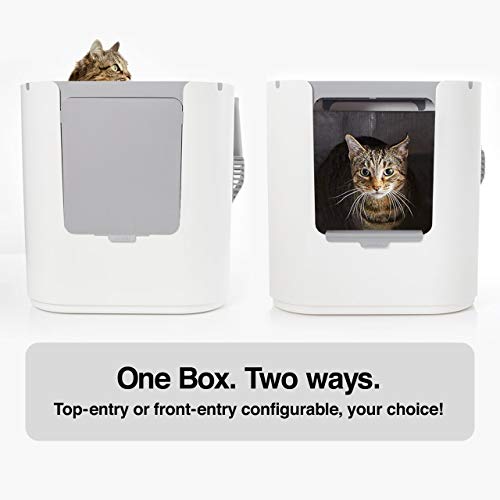
For most healthy, agile cats in U.S. homes, a top-entry litter box can reduce litter tracking and help contain scattered waste. A front-entry litter box is usually easier for kittens, senior cats, large cats, overweight cats, and cats with pain or limited movement.
The best choice depends on your cat’s age, body size, health, habits, and the box location. A clean, roomy box that your cat can enter without stress is more important than the opening style.
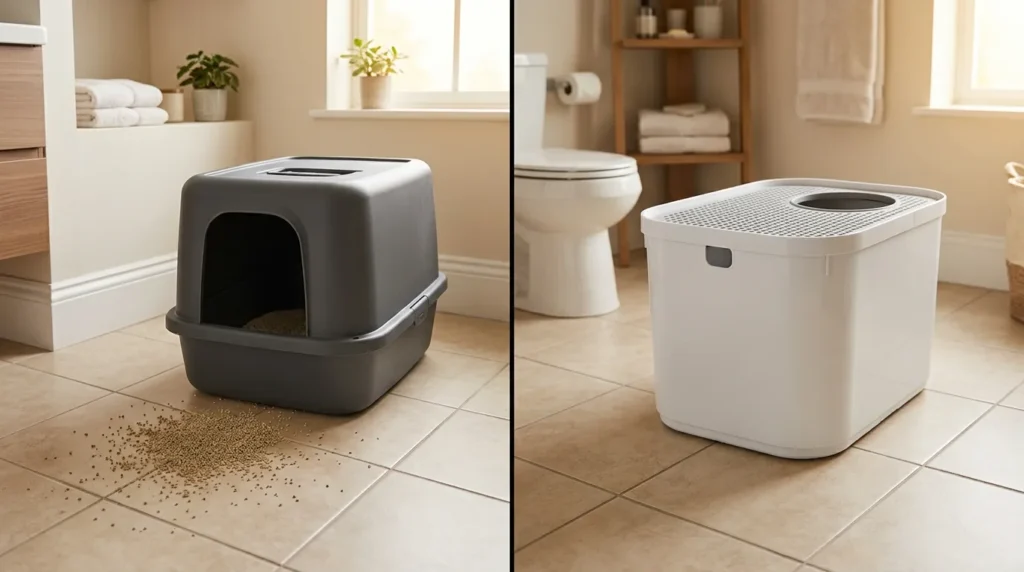
What Is the Difference Between a Top-Entry and Front-Entry Litter Box?
A top-entry litter box has an opening in the lid. The cat climbs onto the lid, enters through the hole, and exits the same way.
A front-entry litter box has a door or open entrance on the side. The cat walks straight in, turns around, uses the litter, and walks back out.
The design changes how your cat enters the box, how litter leaves the box, and how easy it is for you to clean it.
Top-entry litter boxes
Top-entry boxes often offer these features:
- A lid with a hole or covered opening
- Higher walls around the litter
- Less litter thrown over the sides
- A smaller exit path for litter on the cat’s paws
- More privacy for some cats
- A higher step or jump for entry
The lid may catch some litter from the cat’s paws as the cat exits. However, a top-entry box does not stop all tracking. Some cats still carry litter into the home, especially when they use fine or lightweight litter.
Front-entry litter boxes
Front-entry boxes usually include:
- A low or moderate entry point
- A large opening on one side
- Easy access for cats with limited mobility
- Simple scooping and cleaning
- More space for a cat that dislikes enclosed boxes
Some front-entry boxes have high walls or a covered top. These can reduce litter scatter while keeping the entrance easy to reach.
Top-Entry vs. Front-Entry Litter Box: Quick Comparison
Neither design is best for every cat. Use this table as a starting point.
| Feature | Top-entry litter box | Front-entry litter box |
|---|---|---|
| Litter tracking | Often lower, but not eliminated | Can be higher without a mat |
| Access for kittens | Often poor | Usually good |
| Access for senior cats | May be difficult | Usually better |
| Access for cats with joint pain | Often poor | Usually better |
| Privacy | Usually higher | Low to moderate, depending on design |
| Cleaning access | Can be less convenient | Usually easier |
| Escape from dogs | May offer some protection | Depends on the door and location |
| Space for large cats | Varies; opening may feel tight | Often easier to enter, but box must be long enough |
| Odor control | Depends mainly on cleaning and ventilation | Depends mainly on cleaning and ventilation |
| Risk of refusal | Higher for cats that dislike enclosed spaces | Usually lower if the box is open |
| Best use | Healthy, agile cats that track litter | Most cats, especially cats needing easy access |
The main trade-off is simple: top-entry models focus on containment, while front-entry models focus on access.

Which Is Better for Your Cat?
A front-entry litter box is the safer first choice for most cats because it places fewer physical demands on the animal. A top-entry box may work well when your cat is young or adult, active, comfortable jumping, and willing to use an enclosed box.
Choose a top-entry box when:
- Your cat is physically fit and moves well.
- Your cat already uses enclosed boxes without stress.
- Litter tracking is a major problem.
- Dogs or young children disturb the litter area.
- You can provide a second, easier box.
- The opening is large enough for your cat’s body.
- You can clean the box often.
A top-entry box may be useful in a small U.S. apartment where tracking is especially frustrating. It can also help in homes with dogs that try to eat cat waste. Still, the box must not become so difficult to reach that your cat avoids it.
Choose a front-entry box when:
- Your cat is a kitten.
- Your cat is a senior.
- Your cat has arthritis, hip pain, weakness, or balance problems.
- Your cat is overweight.
- Your cat has recently had surgery or an injury.
- Your cat dislikes covered spaces.
- Your cat has stopped using a top-entry box.
- You need to monitor urine or stool closely.
Cats often hide pain. A cat that stops jumping onto furniture may also struggle with a top-entry box. If your cat begins urinating outside the box, do not assume the issue is behavioral. A medical problem, stress, constipation, urinary disease, or box aversion may be involved.
What if you have more than one cat?
In a multi-cat home, access matters even more. Veterinary behavior guidance commonly recommends one litter box per cat, plus one extra. For example:
- One cat: two boxes
- Two cats: three boxes
- Three cats: four boxes
Place the boxes in separate, quiet areas when possible. Several boxes side by side may function like one large toilet area because a cat can still be blocked by another cat.
A top-entry box should not be the only option for a cat that may be chased, cornered, or guarded. A front-entry box with more than one exit path may feel safer.

How Box Size Affects the Choice
The box opening is only one part of the decision. The entire litter box should give your cat room to enter, turn, dig, squat, and leave without touching the sides.
A widely used veterinary guideline is that the litter box should be about 1.5 times the cat’s body length, measured from the nose to the base of the tail. This is a practical target, not a strict rule for every cat.
Measure the box correctly
Measure the usable inside length, not just the outside shell.
For a hypothetical 18-inch cat:
- 18 inches × 1.5 = 27 inches
- A box with about 27 inches of usable interior length would provide more room than a smaller 20-inch box.
Large cats may fit through a top opening but still lack enough space inside. This can make the cat feel trapped or force awkward posture.
Check the opening size
For a top-entry box, measure:
- Opening width
- Opening length
- Distance from the floor to the opening
- Height of the step
- Space inside the box below the opening
For a front-entry box, check:
- Door height
- Door width
- Step-over height
- Interior length and width
- Whether the door swings, flaps, or stays open
A high entry may contain litter better, but it can be painful for a cat with stiff joints. A low entry may help an older cat but allow more litter to escape.
Top-Entry Litter Box Benefits and Limits
Top-entry boxes can solve a real household problem: litter spread. Cats may push litter out while digging, kick it over the wall, or carry it on their paws. A top opening can reduce some of this mess.
Benefits of a top-entry design
Less litter scatter: High walls and a smaller exit may keep more litter inside the box.
More privacy: Some cats prefer a sheltered toilet area. Privacy can also reduce visual distractions.
Possible dog resistance: A top-entry box may be harder for some dogs to access. It is not a secure barrier, though. A determined dog may still reach the box or knock it over.
Useful in tight spaces: The vertical design may fit well in some laundry rooms, bathrooms, or utility areas.
Limits of a top-entry design
The cat must climb or jump: This can be hard for kittens, seniors, and cats with pain.
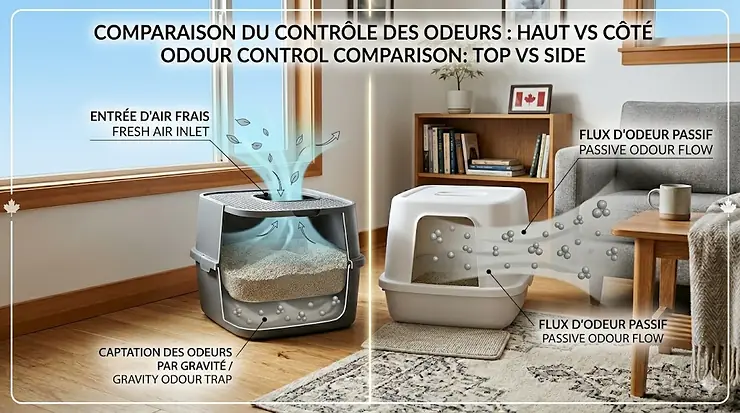
The lid can trap odor: A covered box may hold odor inside until you open it. Odor control still depends on scooping, washing, litter choice, and ventilation.
Some cats dislike enclosed boxes: A cat may feel cornered, especially if another cat, dog, or child can wait outside the box.
Cleaning may take more effort: You may need to remove the lid before scooping. A narrow opening can also make it harder to see wet litter.
The box can be hard to inspect: Owners may miss changes in urine volume, stool, or blood when the box is dark or difficult to view.
A top-entry box should not be promoted as a universal odor solution. Its effect on odor depends more on cleaning and airflow than on the direction of entry.

Front-Entry Litter Box Benefits and Limits
Front-entry boxes offer the most direct route. This makes them a strong choice for cats that need easy access or do not like covered spaces.
Benefits of a front-entry design
Easy access: A cat can walk in without climbing.
Better for mobility limits: A low entry helps cats with arthritis, weakness, or recovery needs.
Simple monitoring: You can see the litter and spot changes during routine scooping.
Flexible placement: A front-entry box can work in a bathroom, bedroom, laundry room, or quiet corner.
Usually easier to clean: A wide opening gives your scoop more room to move.
Limits of a front-entry design
More litter may escape: Cats can kick litter through the opening or carry it out.
Less privacy: Some cats prefer a covered space and may feel exposed.
Dogs may reach the litter: A front opening can make access easier for dogs.
Low walls may cause urine leaks: Some cats stand while urinating. A box with low sides may not contain the spray.
You can improve a front-entry setup with a large litter mat, high side walls, a washable floor tray, and a quiet location. Do not place the box directly beside food or water.

Which Design Has Better Odor Control?
Neither top-entry nor front-entry design controls odor by itself. Odor comes mainly from urine, feces, bacteria, litter type, ventilation, and cleaning habits.
Use these practices with either design:
- Scoop urine clumps and stool at least once each day.
- Remove waste sooner if your cat is sensitive or several cats share the box.
- Keep enough litter in the box for digging, based on the litter maker’s directions.
- Wash the box with mild unscented soap and water during regular litter changes.
- Avoid strong scents, bleach mixtures, ammonia-based cleaners, and heavily perfumed litter.
- Dry the box fully before adding fresh litter.
- Keep the box in a dry area with reasonable airflow.
- Replace cracked or deeply scratched plastic boxes.
A scented box or air freshener may hide odor from people while making the area unpleasant for cats. Cats have a much stronger sense of smell than humans, so a clean, unscented setup is often the better starting point.
If odor suddenly becomes much stronger, check for:
- A box that is too small
- Too few boxes
- Wet litter under the main layer
- A cracked base
- Urine outside the box
- Diarrhea or unusually strong stool
- A cat that is urinating more often
A sudden change in urine or stool odor, volume, or frequency may need veterinary attention.
Which Design Tracks Less Litter?
Top-entry boxes often track less litter than open front-entry boxes, but the result depends on the litter and the cat.
Fine litter can stick to paws. Lightweight litter can travel farther. Large pellets may track less but may feel uncomfortable to some cats. Your cat’s digging style also matters.
To reduce tracking:
- Put a large litter mat outside the exit.
- Use a mat with two layers or a textured surface that catches loose litter.
- Place the box on a stable, easy-to-clean floor.
- Sweep or vacuum around the box often.
- Keep the litter depth consistent.
- Trim paw fur only if your veterinarian or groomer recommends it.
- Do not force a cat to use a top-entry box solely to reduce mess.
A front-entry box with high sides and a good mat may create less total trouble than a top-entry box your cat avoids.
How to Introduce a Top-Entry Box
If your cat already uses a front-entry box, change slowly.
- Put the new box beside the old one.
- Leave the top lid off at first if the design allows it.
- Add the same litter your cat already accepts.
- Let your cat inspect the box without being placed inside.
- Keep the old box available for at least several days.
- Add the lid only after your cat uses the open version.
- Watch for hesitation, repeated attempts to leave, or accidents near the box.
- Keep the old box if your cat clearly prefers it.
Never push a cat through the opening or hold the cat inside. That can create a negative association with the box.
Signs the transition is going well include:
- The cat enters without coaxing.
- The cat digs and turns normally.
- The cat exits calmly.
- There are no accidents nearby.
- The cat continues to use the box over several days.
If the cat stops using the box, remove the lid and return to the last design the cat accepted.
Common Mistakes to Avoid
Buying a box that is too small
A box can look large from the outside but have little usable space inside. Measure the interior and compare it with your cat’s body length.
Choosing a top-entry box for a cat with pain
A cat with arthritis may still climb into a top-entry box sometimes. That does not prove the design is comfortable. Watch for slower movement, hesitation, or accidents.
Using only one box
One box may work for one cat in a small home, but many cats benefit from more than one location. Multiple boxes can reduce crowding and improve access.
Hiding the box in a hard-to-reach place
Do not put the only box behind a closed door, at the end of a narrow hallway, or in a noisy area beside a washer and dryer.
Moving the box suddenly
Cats may keep returning to the old location. Move a box a few inches at a time when possible.
Ignoring accidents
Repeated accidents are a signal, not misbehavior. Clean the area with an enzymatic cleaner made for pet urine. Then assess the box, litter, location, household stress, and health.
If your cat strains to urinate, cries in the box, produces little or no urine, or repeatedly visits the box, contact a veterinarian promptly. A blocked urinary tract is an emergency, especially in male cats.
How to Choose: A Simple Decision Guide
Use this order:
- Rule out access problems. Can your cat reach the box, step into it, turn around, and leave comfortably?
- Consider health and age. If your cat has pain, weakness, obesity, or recent surgery, choose front entry.
- Consider behavior. If your cat dislikes covered spaces, choose an open front-entry model.
- Consider household needs. If tracking or dog access is the main issue, test a top-entry model only if your cat can use it comfortably.
- Check size. A large, open box is better than a small box with a clever design.
- Provide a backup. Keep another acceptable box available during any change.
- Watch the cat, not just the product. The cat’s use pattern is the most useful test.
Best choice by situation
| Situation | Better starting choice |
|---|---|
| Healthy adult cat with heavy litter tracking | Top-entry, if the cat accepts it |
| Kitten | Low front-entry |
| Senior cat | Low front-entry |
| Cat with arthritis | Low front-entry |
| Large or overweight cat | Large front-entry |
| Cat that dislikes covered spaces | Open front-entry |
| Home with a dog that raids the box | Top-entry or protected front-entry area |
| Cat that urinates standing up | High-sided front-entry or high-sided covered box |
| Multi-cat home | Several large boxes with easy access |
| Cat with recent urinary or bowel problems | Easy-clean front-entry for monitoring |
Frequently Asked Questions
Do cats prefer top-entry or front-entry litter boxes?
There is no single preference shared by all cats. Many cats accept front-entry boxes because they are easy to reach and leave. Some active cats prefer the privacy of a top-entry box. Your cat’s behavior is more useful than a general product claim.
Are top-entry litter boxes bad for cats?
Top-entry boxes are not automatically bad. They can be unsuitable for cats that are young, old, overweight, injured, or affected by joint pain. They may also cause refusal in cats that dislike enclosed spaces. Offer an easier box when access may be difficult.
Can a top-entry litter box stop litter tracking?
It can reduce tracking for some cats, but it cannot eliminate it. Litter type, paw shape, digging behavior, and the mat outside the box also affect tracking.
Is a front-entry litter box better for kittens?
Usually, yes. Kittens may struggle with a high step or top opening. A low front-entry box lets a kitten enter and exit quickly. Use a box with enough room for growth and keep it in an easy-to-reach area.
Can a senior cat use a top-entry litter box?
Some senior cats can, but a top-entry box is not the safest default. Joint pain, reduced balance, or weakness can make climbing difficult. A low front-entry box is usually more practical. Ask a veterinarian to assess pain if your older cat changes litter habits.
How many litter boxes should I have?
A common starting guideline is one box per cat plus one extra. Spread them through the home when possible. Add boxes on each floor if your cat has trouble using stairs or if the home is large.
What should I do if my cat refuses the new litter box?
Return the old box, place the new one nearby, and use the familiar litter. Make one change at a time. If your cat continues to avoid all boxes, has accidents, strains, or urinates often, contact a veterinarian.
Final Recommendation
For most households, choose a large front-entry litter box unless your cat is healthy, agile, and comfortable using a top-entry model. A top-entry box is most useful when litter tracking, privacy, or dog access is the main concern.
The strongest setup may combine both styles: a low front-entry box for easy access and a top-entry box for an active cat that accepts it. Keep each box clean, place it in a quiet location, and let your cat’s comfort guide the final choice.
Evidence and Reference Points
This guide follows commonly cited feline-care principles from:
- American Association of Feline Practitioners and International Society of Feline Medicine environmental needs guidelines
- Ohio State University Indoor Pet Initiative: litter box care
- International Cat Care: litter trays
- Cornell Feline Health Center: house soiling
These sources support practical principles such as easy access, suitable box placement, adequate box numbers, and prompt attention to health-related changes. They do not establish that one entry style is best for every cat.