
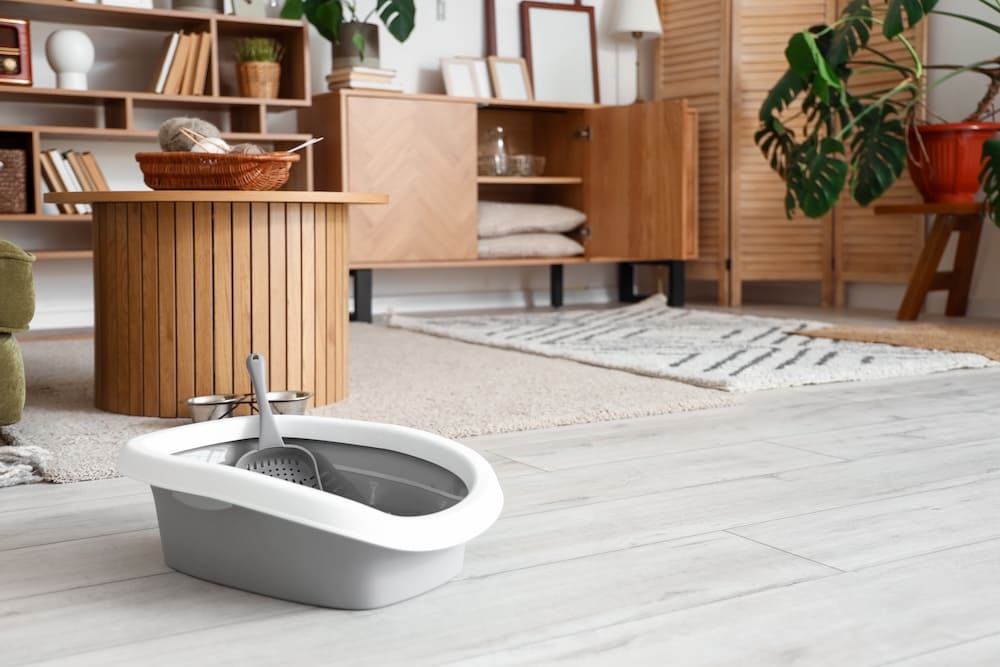
The best place for a litter box in a small U.S. apartment is a quiet, easy-to-reach spot with good airflow, low foot traffic, and a clear escape route. A bathroom corner, ventilated utility area, or quiet part of a bedroom often works well.
Keep the box away from your cat’s food and water. Avoid busy hallways, loud appliances, tight closets, and any place where a door could block access. In a small home, the goal is not to hide the box at any cost. The goal is to make it safe, private, and easy for your cat to use every day.
The Best Litter Box Locations in a Small Apartment
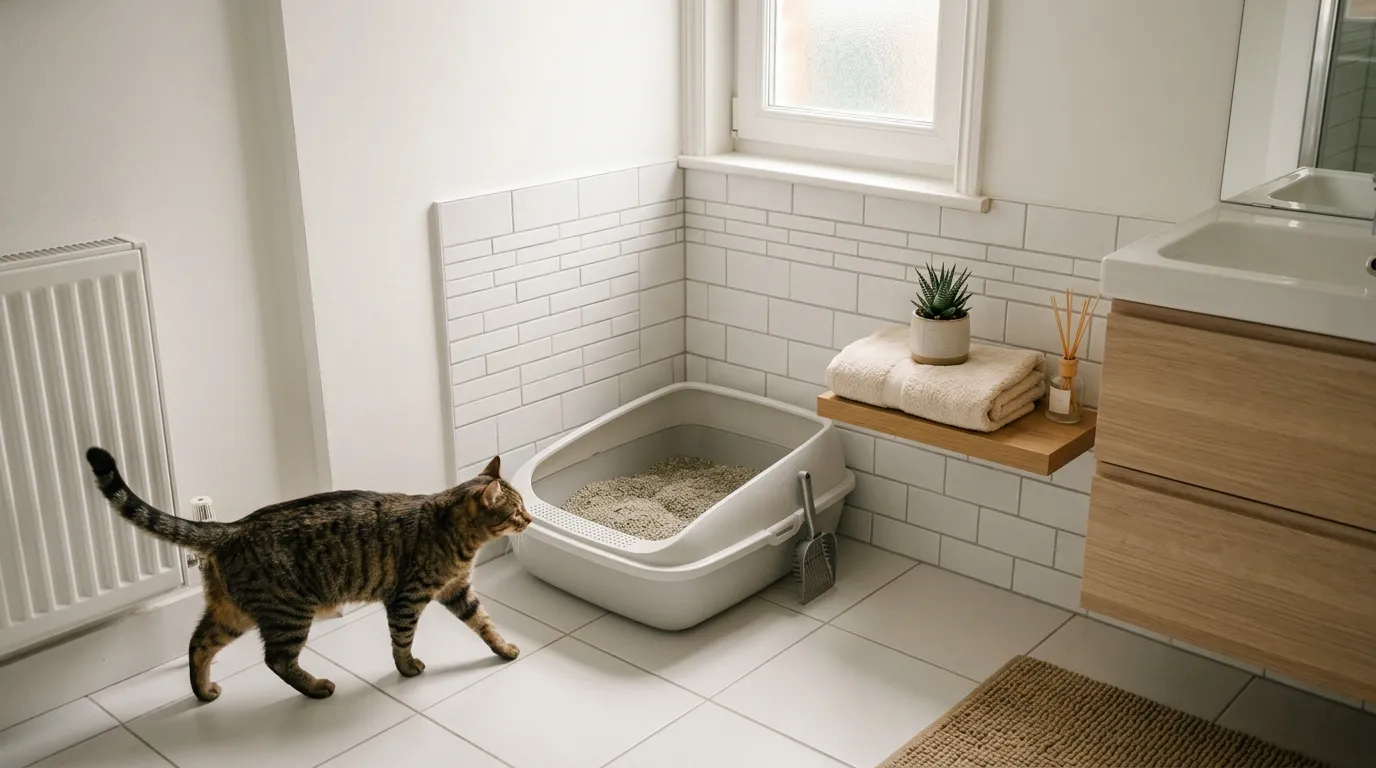
Choose a location where your cat can reach the box at all times. The space should feel calm but not trapped. Your cat should be able to see the room, enter and leave without trouble, and avoid sudden noise or human traffic.
Good options include:
- A quiet corner of the bathroom
- A large, well-ventilated closet with the door secured open
- A corner of a bedroom
- A low-traffic part of a home office
- A spacious laundry area, away from the washer and dryer
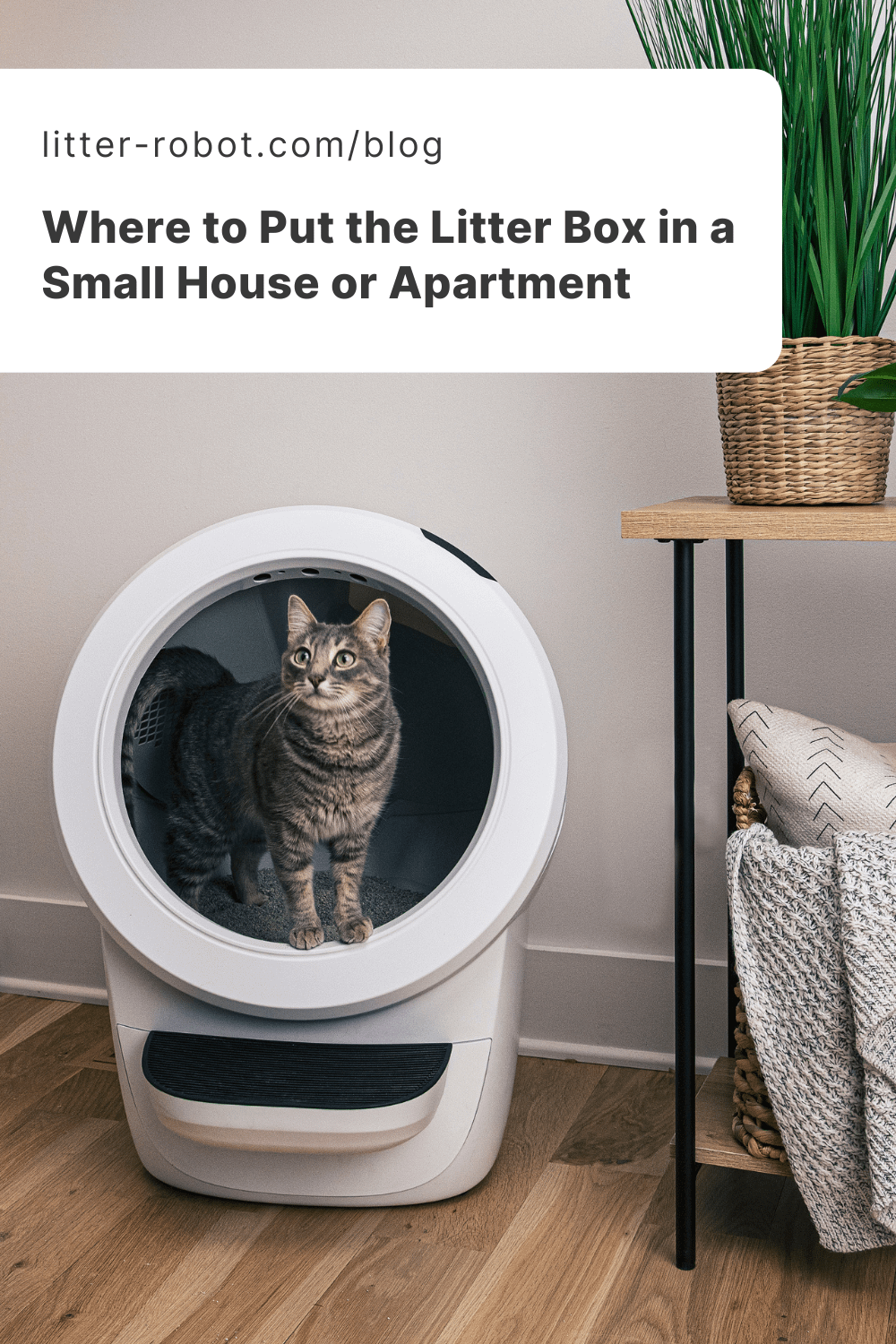
- Under a console table or open shelf, if the box remains easy to reach
- A screened balcony only when it is fully safe, enclosed, climate-controlled, and accessible year-round
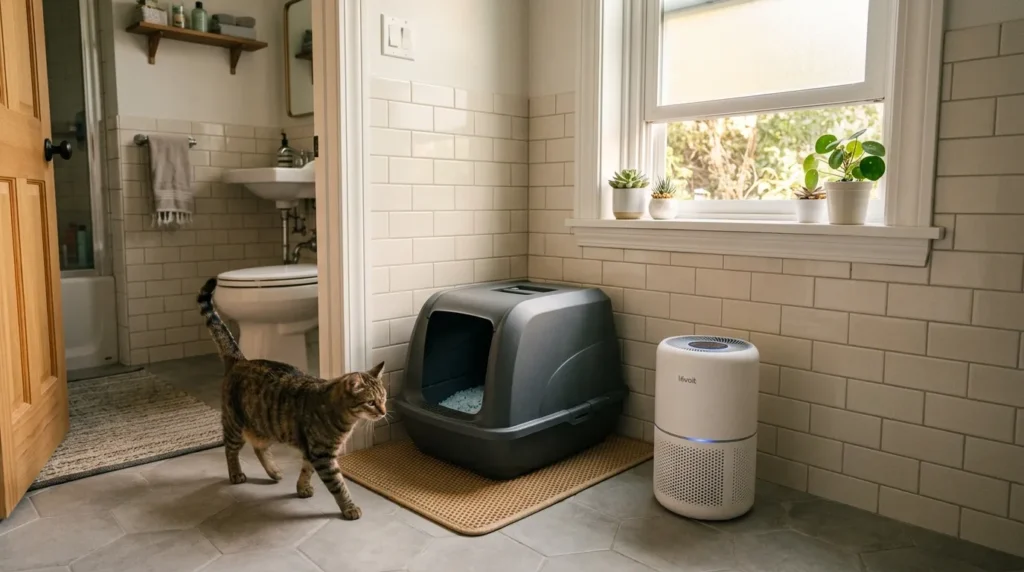
A bathroom is often practical because hard floors are easy to clean. However, do not place the box beside a loud exhaust fan, in a narrow space near the toilet, or where a closed bathroom door could leave your cat locked out.
A bedroom can work well if the box is far from the bed and cleaned often. A home office may also be suitable when your cat will not be startled by chairs, visitors, or frequent movement.
The American Association of Feline Practitioners and International Society of Feline Medicine recommend placing litter boxes in quiet, accessible areas where cats can use them without feeling cornered. Their guidance also supports giving cats more than one way to avoid conflict in multi-cat homes.
How to Choose the Right Spot: A Simple Test
Before putting the box in place, test the location from your cat’s point of view. A good spot passes five checks:
- Access: Can your cat reach it all day and night?
- Quiet: Is it away from sudden sounds and heavy foot traffic?
- Escape: Can your cat leave without passing a dog, child, or another cat?
- Space: Can your cat turn, dig, squat, and cover waste?
- Cleanliness: Can you scoop and clean the box without difficulty?
A spot may look convenient to you but still feel unsafe to your cat. For example, a box beside a furnace may be warm and out of the way, but the fan may start without warning. A box behind a bathroom door may offer privacy, but the door can block access.
Use a location scorecard
Score each possible location from 0 to 2:
| Factor | 0 points | 1 point | 2 points |
|---|---|---|---|
| Access | Often blocked | Usually open | Always open |
| Noise | Loud or sudden | Some noise | Quiet |
| Escape route | Trapped or cornered | Limited exit | Clear exit |
| Space | Too tight | Barely adequate | Comfortable |
| Cleaning access | Hard to reach | Manageable | Easy |
Choose the highest-scoring location. If two places score the same, select the one that is easier to clean and farther from food preparation areas.
This method helps in studio apartments, where the box may need to share space with furniture. A location that is slightly less hidden but easier to access is usually better than a concealed box that your cat avoids.
How Many Litter Boxes Do You Need?
The usual recommendation is one litter box per cat, plus one extra. This means one cat should ideally have two boxes, while two cats should have three.
That rule can be difficult in a small apartment. If space is limited, start with the largest number of boxes you can reasonably maintain. For one cat, place boxes in separate locations if possible. Two boxes side by side may look like two choices to you, but many cats treat them as one area.
Multiple boxes matter because cats may prefer one box for urine and another for stool. They also reduce the chance that a dirty box, blocked doorway, or conflict with another pet will cause an accident.
In a one-bedroom apartment, possible arrangements include:
- One box in the bathroom and one in the bedroom
- One box in the bathroom and one in a quiet living-room corner
- One box in a bedroom and one in a ventilated office area
- One large box in the main living space if your cat refuses a second location
Do not put every box in a single hidden cabinet. Spread them out when possible so your cat always has a safe option.
If your cat suddenly stops using the box, do not assume the location is the only cause. Pain, urinary disease, constipation, arthritis, stress, and litter aversion can also lead to accidents. A veterinary check is appropriate when the change is sudden or continues.

How Far Should the Litter Box Be From Food and Water?
Place the litter box as far from food and water as your apartment allows. Cats generally prefer to eat and eliminate in separate areas. Keeping these resources apart also reduces the chance that litter dust, waste, or odor will affect the feeding area.
There is no single required number of feet for every home. Use separate rooms when possible. If you live in a studio, create clear zones:
- Keep food and water on one side of the room.
- Put the box in a bathroom or far corner.
- Use a screen or furniture barrier without blocking ventilation.
- Avoid placing the box directly beside food bowls.
- Keep litter tools and waste bags away from food storage and preparation areas.
A water fountain does not make a litter box beside the feeding area a good choice. The key issue is separation, not the type of bowl.

Should You Hide a Litter Box in a Closet or Cabinet?
You can place a litter box in a closet or cabinet only if it remains open, large enough, clean, and well ventilated. Never seal a cat inside a small box cabinet without adequate airflow and a reliable entrance.
A hidden litter box can reduce visual clutter, but it can also trap odor and make cleaning harder. Some enclosed furniture has a small opening that forces a large cat to squeeze through or makes it difficult to escape. That design can discourage use.
If you use a closet:
- Remove stored items near the box.
- Secure the door so it cannot swing shut.
- Keep the entrance wide enough for your cat.
- Leave room for the cat to turn around.
- Check for odor and moisture each day.
- Keep cleaning products and chemicals out of reach.
An open cabinet or table may offer a better compromise than a fully enclosed unit. It hides some of the box while preserving airflow and visibility.
Do not use a sealed plastic storage bin as a litter-box room unless it has been designed and modified safely for this purpose. Poor ventilation can increase odor and may make the space unpleasant for both you and your cat.

Where Not to Put a Litter Box
Avoid any location that is loud, hard to reach, or easy to block. Common poor choices include:
- Beside a washer, dryer, furnace, or water heater
- Near a speaker or television with sudden loud sounds
- Inside a cabinet that can close
- Behind a closed bathroom or closet door
- In a narrow hallway
- Beside a food or water bowl
- In a high-traffic entryway
- On a balcony exposed to heat, cold, rain, or unsafe falls
- Near cleaning chemicals, insect bait, or other hazards
- In a place where a dog or another cat can guard the entrance
Laundry rooms deserve special care. A cat may tolerate the room when the machines are off but avoid it when they start. If the laundry area is your only option, place the box as far from the machines as possible and observe whether your cat uses it during a full wash and dry cycle.
Do not place a litter box near an apartment exit if your cat may bolt through the door. Use a barrier only when it does not block the cat’s access or create a trap.

How to Set Up a Litter Box in a Small Apartment
Start with a box that gives your cat enough room. The AAFP and ISFM guidelines state that a box should be about 1.5 times the length of the cat, measured from the nose to the base of the tail. Many store-bought boxes are too small for large cats.
Follow these steps:
- Measure the available space. Include room for your cat to enter, turn, and leave.
- Choose a large, stable box. A low entry helps kittens, older cats, and cats with mobility problems.
- Add unscented litter. Strong fragrance can bother some cats.
- Place a mat outside the box. This helps catch loose litter without blocking the exit.
- Keep tools nearby. Store the scoop and waste bags where you can use them easily, but keep cleaners away from your cat.
- Scoop at least once each day. More frequent scooping may be needed in a small home or with several cats.
- Wash the box regularly. Use mild soap and water, then rinse and dry it well.
- Watch your cat’s behavior. Check whether your cat enters easily, digs, covers waste, and leaves without hesitation.
Avoid sudden changes in box type, litter texture, or location. If a move is necessary, place the new box near the old one for a short period. Once your cat uses it reliably, remove the old box or move it a small distance at a time.

How to Control Litter Box Odor in a Small Apartment
Odor control starts with routine cleaning, not perfume. Scoop waste daily and remove wet clumps before they spread odor through the room. In a small apartment, twice-daily scooping may be useful, especially with more than one cat.
Use these steps:
- Choose unscented, low-dust litter that your cat accepts.
- Keep the litter depth consistent with the product instructions and your cat’s preference.
- Empty and wash the box when odor remains after scooping.
- Use a lined trash can or sealed waste container.
- Improve airflow without creating a draft directly over the box.
- Clean accidents with an enzymatic pet-odor cleaner.
- Replace cracked or permanently scratched boxes.
Avoid air fresheners, essential oils, and strong disinfectants around the box. Some fragrances can irritate cats or cause them to avoid the area. Never mix cleaning products, especially products containing bleach and ammonia.
If odor suddenly becomes much stronger, check for hidden accidents, a damaged box, changes in litter, or a health problem. Strong-smelling urine, frequent urination, straining, or blood in the urine needs veterinary attention.

What to Do if Your Cat Refuses the New Location
If your cat stops using the box after a move, return it to the last location that worked if you can. Then make changes slowly. Move the box only a few inches each day, or add a second box at the new site.
Check these possible causes in order:
- Access: Is a door closed or is furniture blocking the path?
- Noise: Did an appliance, fan, or heater start making noise?
- Litter: Did the brand, scent, texture, or depth change?
- Box: Is it too small, covered, dirty, or unstable?
- Conflict: Can another pet interrupt or watch your cat?
- Health: Is your cat showing pain, urgency, constipation, or other changes?
Do not punish a cat for an accident. Punishment can increase fear and make box avoidance worse. Clean the area fully so the smell does not draw your cat back to the same spot.
Contact a veterinarian promptly if your cat strains to urinate, makes repeated trips with little urine, cries in the box, has blood in the urine, vomits, becomes weak, or cannot urinate. Inability to urinate can be an emergency, particularly in male cats.

Best Litter Box Placement by Apartment Type
The right choice depends on the layout, not just the square footage.
| Apartment layout | Practical first choice | Main caution |
|---|---|---|
| Studio | Bathroom corner or quiet far corner | Separate the box from food and sleeping areas |
| One-bedroom | Bathroom plus bedroom or office | Keep bedroom box away from the bed |
| Loft | Quiet zone on the main level | Avoid locations that require difficult stairs |
| Apartment with dogs | Room with a cat-only escape route | Prevent dogs from guarding or entering |
| Apartment with children | Quiet area with a stable barrier | Keep children from disturbing the cat |
| Senior-cat home | Low-entry box on the cat’s main level | Avoid stairs and slippery floors |
If your cat has arthritis or limited mobility, place a low-entry box close to the areas where the cat spends time. A senior cat may not reach a box across the apartment quickly enough, even if the location once worked.
If you have a dog, use a baby gate with a cat-sized opening or a room the cat can access but the dog cannot. The cat must never be forced into a narrow passage to reach the box.

Common Mistakes to Avoid
The most common mistake is choosing a location that looks tidy but feels unsafe to the cat. Hiding the box behind a door, inside a cramped cabinet, or beside a loud appliance can create avoidance.
Other mistakes include:
- Using a box that is too small
- Placing the box beside food
- Relying on scented litter to cover poor cleaning
- Putting several boxes side by side
- Changing litter and location at the same time
- Blocking the only exit
- Ignoring a sudden change in bathroom habits
- Waiting too long to clean accidents
- Using harsh chemicals near the box
- Moving the box without a transition period
A litter box does not need to be invisible. It needs to be dependable. A simple box in a quiet corner is often more successful than an attractive enclosure that limits movement or traps odor.

Frequently Asked Questions
Can I put a litter box in my bedroom?
Yes. Place it as far from the bed as possible, keep it clean, and provide good airflow. A bedroom box may be useful when the bathroom or living area is too busy.
Can a litter box go in the bathroom?
Yes, but keep the bathroom door open or install a cat door. Avoid placing the box beside a loud fan, near cleaning products, or where the toilet or furniture blocks the exit.
Is it safe to put a litter box in a closet?
It can be safe if the closet stays open, has enough space and airflow, and allows your cat to enter and leave freely. Do not shut the cat inside a small, sealed closet.
How do I hide a litter box in a small apartment?
Use an open cabinet, privacy screen, or piece of furniture with wide openings and good airflow. Do not sacrifice access, escape space, or cleaning access for appearance.
How often should I clean a litter box?
Scoop at least once daily. Wash the box regularly and clean it sooner if odor remains, the litter becomes wet, or several cats use it.
Why did my cat stop using the litter box?
Possible causes include a dirty or small box, an unpleasant location, stress, conflict with another pet, litter changes, or illness. Sudden changes, straining, blood, pain, or little urine require veterinary advice.
Conclusion
The best litter box location in a small apartment is quiet, open, clean, and easy for your cat to reach. Start with a bathroom corner, quiet bedroom area, or ventilated utility space. Keep the box away from food, loud machines, closed doors, and places where another pet can block the exit.
Set up the largest practical box, scoop it every day, and change the location slowly if needed. If your cat suddenly avoids the box or shows signs of pain, treat the problem as a possible health issue and contact a veterinarian.
Your next step is simple: inspect your apartment, score two or three possible locations for access, noise, escape, space, and cleaning, then choose the highest-scoring spot.